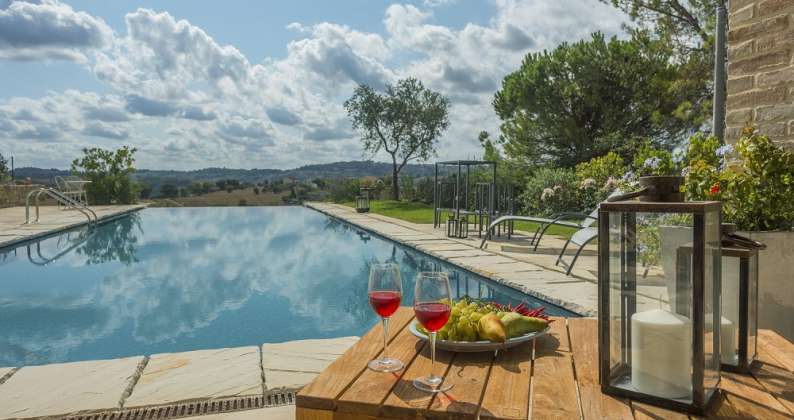
When talking about swimming pools with our clients, there is one thing we often hear: nobody wants to become a slave to their own swimming pool.
And that is understandable. Having a swimming pool should be a pleasure, not an ongoing commitment involving cleaning, checks and maintenance.
Compared to thirty years ago, today we have a wide range of technologies available that allow us to automate various functions and make pool management easier.
The goal is to find the right balance between technology, automation and manual intervention. Because even with a highly automated swimming pool, some routine and extraordinary maintenance operations are still necessary.
Which maintenance operations need to be carried out manually?
Let's start with an important point: there is no such thing as a completely self-sufficient swimming pool that never requires any intervention.
There are some operations that must be carried out manually, such as cleaning the floats, removing debris from the pool, cleaning the balance tank, backwashing the filter and checking the chemicals.
These are all activities that are part of normal pool management and are worth knowing about before purchasing a swimming pool.
In fact, customers' concerns often arise from information they have read or heard elsewhere, which may be incomplete or inaccurate. That is why it is important to clearly explain how maintenance works and which tools can genuinely help make it easier.
The pool cleaning robot: an important aid in keeping your swimming pool clean
The first piece of equipment we definitely recommend having is a pool cleaning robot.
It is a very important piece of equipment because it helps keep the bottom of the swimming pool clean, significantly reducing manual work.
However, there is one thing to bear in mind: the robot itself also needs maintenance. At the end of the season, it is important to carry out winter maintenance and, when necessary, perform a small service to keep it working efficiently.
It is also worth remembering that the robot cannot clean every area of the swimming pool. Some areas, such as the beach-entry area, still require manual intervention using a leaf net to move debris into the main pool.
In short, the robot is a great ally, but it does not completely replace manual cleaning.
The automatic water treatment control unit
Another essential tool for simplifying pool management is the automatic water treatment control unit.
Whether it is a chlorine-based system, a saltwater system or another type of treatment system, the control unit helps keep the water within the correct parameters by monitoring and adjusting the dosage of the chemicals.
In this case too, however, it is important to understand that automation does not completely eliminate the need for manual intervention.
For example, the probes need to be calibrated periodically and shock treatments must be carried out when necessary.
Why? The control unit operates within specific adjustment ranges, but there are situations in which normal operation is not sufficient.
Think of an exceptionally hot day, a swimming pool used by twenty people, or a party with lots of guests. In these situations, the load on the pool increases and it may be necessary to carry out a manual shock treatment to bring the water back to the correct conditions.
The control unit also needs maintenance: the probes must be replaced periodically, generally every two years, and the electrolysis cell, in systems that use one, must also be checked and replaced when necessary.
These are routine and extraordinary maintenance costs that the professional should communicate during the consultation stage. This allows customers to make an informed decision, knowing not only the initial cost of the system but also the costs required to keep it working efficiently over time.
Automatic filter backwashing: is it really necessary?
Another system that can help with pool management is the automatic electric valve for filter backwashing.
Essentially, it allows the filter washing process to be automated, starting it at predetermined time intervals.
It is a convenient solution, but among all the automation options available, it is probably one of the least essential.
Today, thanks to more advanced filter media, filter backwashing may only be necessary every two weeks, depending on the system and the conditions under which the swimming pool is used.
For this reason, this is an automation feature that can also be considered and installed at a later stage.
Not everything needs to be automated straight away: the important thing is to understand which tools really make a difference to day-to-day management.
Remote monitoring for greater peace of mind when managing your swimming pool
Another interesting option is to connect the swimming pool to a remote monitoring system.
Through an app, it is possible to receive notifications and alerts when chemicals are running low, when certain water parameters are incorrect or when a fault occurs in the system.
This makes it possible to identify potential problems in advance and take action before they become more serious.
However, there is a difference between having an app that you monitor yourself and relying on a company that monitors your swimming pool remotely.
If you have little free time, you may not necessarily want to keep opening the app, checking the values and making sure everything is working correctly.
For this reason, it can be very useful to rely on a company that takes care of remote monitoring and can arrange a service visit directly whenever necessary.
This way, technology does not simply notify you of a problem: there is also a professional who can take care of it.
All these systems are useful and work well, but it is important to be aware that they also require maintenance and may involve additional costs.
An overflow swimming pool helps reduce cleaning problems
There is another aspect that is often overlooked when discussing maintenance: the type of swimming pool.
An overflow swimming pool, for example, can help solve several problems related to water cleanliness.
Think of surface debris, leaves, algae and that annoying oily film that can form on the water's surface.
In skimmer pools, water circulation depends on the position and number of skimmers and return inlets. If circulation is not properly distributed, some areas may become more difficult to keep clean.
In an overflow swimming pool, on the other hand, the circulation system is generally more uniform. Water is collected along the perimeter through the overflow channel and returned to the pool through several return inlets.
This promotes more uniform water circulation and better collection of surface debris.
Of course, an overflow swimming pool also requires maintenance. However, proper design of the circulation and filtration system can make a significant difference to day-to-day management.
Relying on professionals so you don't become a slave to your swimming pool
As we have seen, technology can genuinely make swimming pool management easier today. Pool cleaning robots, automatic control units, electric valves and remote monitoring systems are all tools that help reduce manual intervention and keep the water in the right condition.
But the point is not to automate everything.
The key is to design a swimming pool that is easy to manage, choose the right equipment and understand from the outset which maintenance operations are required and what they will cost.
That is why it is important to rely on professionals who know how to listen to customers' needs and recommend the most suitable solutions, without suggesting automation features that may not actually be necessary.
If you are thinking about building a swimming pool or would like to make managing your existing one easier, we can help you find the best solution.
We work in the Marche, Umbria and Abruzzo regions and support our clients with the design, construction and selection of swimming pool systems and technologies.
Get in touch with us: we will be delighted to help you create a swimming pool to enjoy and make the most of, without becoming a slave to it!